

Sound Waves vs Electromagnetic Waves
The two Major categories of waves in the Universe are mechanical and electromagnetic. Most of waves fall in this category.
Music is related to mechanical waves, while color is related to electromagnetic waves.
It is common to confuse these two types of wave when talking about vibrational therapies. And these therapies use both mechanical and electromagnetic vibrations.
Sound waves are produced by a disturbance in the air, and electromagnetic waves are produced by disturbance in the electromagnetic field. Even though, both are of distinct nature hence unable to interact, we will see that they can actually influence each other in various forms.

Sound Waves
Sound is produced when two objects interact and create vibrations. These vibrations disturb the surrounding air molecules, setting off a chain reaction of compressions that travels outward as a wave. When this wave reaches the eardrum, it is transmitted to the brain, where it is interpreted as sound.
Sound can also move through liquids and solids, and its speed depends on the medium. It travels slowest in gases, faster in liquids, and fastest in solids, meaning the denser the material, the quicker sound moves through it. Temperature also plays a role, since it affects how easily particles vibrate. Because sound relies on vibrations in matter, it is a fundamental phenomenon present throughout the physical world.
In general, sound requires a medium—such as air, liquid, or solid—to propagate, which is why it cannot travel through the vacuum of space. However, as explored further in this course, sound-related information can still be transmitted through space when converted into electromagnetic signals.
Sound waves are a type of mechanical wave. Mechanical waves can be classified into three main types: transverse, longitudinal, and surface waves. Common examples include water waves, sound waves, and seismic waves. Sound waves are typically illustrated using graphs of amplitude versus time, where amplitude reflects variations in air pressure. These pressure changes create alternating regions of compression and rarefaction, forming patterns that the brain decodes as sound.
Although sound waves are often represented in two dimensions for simplicity, they actually propagate in three dimensions, spreading outward in all directions from their source.


Three Key Properties of a Sound Wave
Amplitude
Amplitude describes how strong the pressure changes are in air molecules when a sound is produced. It determines how loud a sound is and is measured in decibels (dB). The decibel scale is logarithmic, not linear. This means a sound at 20 dB is ten times more intense than one at 10 dB, not just twice as intense. Similarly, 30 dB is ten times more intense than 20 dB. However, our ears perceive these increases differently—for example, a 20 dB sound may seem only about twice as loud as a 10 dB sound. The threshold of hearing is 0 dB, while sounds around 120 dB can cause pain.
Frequency
Frequency refers to how often a sound wave completes a cycle of compression and rarefaction. It is measured in Hertz (Hz), which counts the number of cycles per second. A higher frequency means more cycles per second and results in a higher-pitched sound.
Wavelength
Wavelength is the distance between successive peaks of a sound wave, essentially representing the length of one complete cycle. It is inversely related to frequency: shorter wavelengths correspond to higher frequencies, while longer wavelengths correspond to lower frequencies. Since sound travels at a constant speed (about 330 meters per second), increasing frequency requires shorter wavelengths. Audible sound wavelengths range roughly from 17 meters to 17 millimeters.
Relationship Between Frequency and Amplitude
Frequency and amplitude are independent properties. Two sounds can have the same frequency (same pitch) but different amplitudes (different loudness), or the same amplitude but different frequencies.


Electromagnetic Waves
Electromagnetic force can appear in the form of waves. Similar to sound waves, these waves vibrate at specific frequencies, and those frequencies determine their characteristics. Electromagnetic waves also have an amplitude, often described as intensity or photon energy.
Electromagnetic radiation is produced when a charged particle—such as an electron—is accelerated by an electric field. This acceleration causes the particle to move, generating oscillating electric and magnetic fields. These fields travel perpendicular (at 90 degrees) to each other as a packet of light energy known as a photon. The motion of the particle determines the frequency of the resulting electromagnetic wave.
Electromagnetic waves can be represented in a way similar to sound waves. However, instead of amplitude alone, they are often described in terms of intensity or photon energy, which depends on the amount of energy supplied to the system.
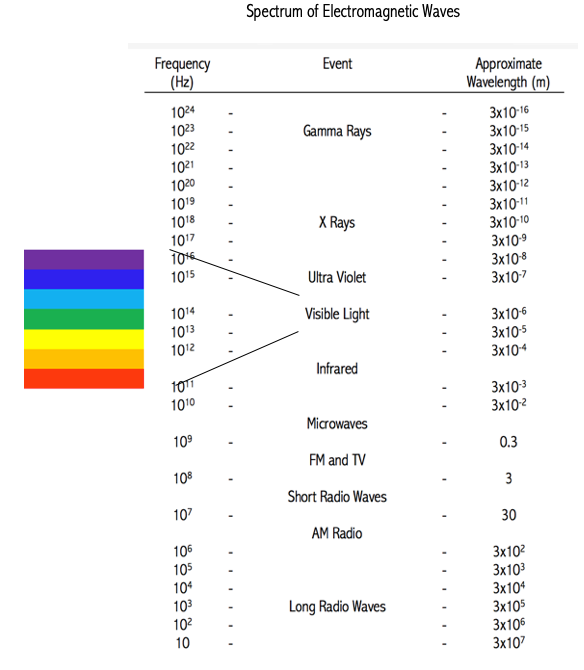
Although both sound and electromagnetic waves can be illustrated similarly, they are fundamentally different in nature, and their frequency ranges differ greatly. Sound waves audible to humans fall between 20 Hz and 20,000 Hz. In contrast, the visible portion of the electromagnetic spectrum lies roughly between 400 and 790 THz, and the full electromagnetic spectrum extends far beyond this range without a strict upper limit.
Because electromagnetic waves can have extremely high frequencies, their wavelengths are correspondingly very small. Higher frequency means shorter wavelength, often on the scale of nanometers (one billionth of a meter). A nanometer is roughly the width of about ten atoms lined up side by side. This scale is important because wavelength influences how electromagnetic waves interact with matter, including the human body. This principle is also relevant in both sound-based and electromagnetic-based therapies.
For comparison, the wavelength of audible sound ranges from about 17 meters to 17 millimeters, which is vastly larger than that of electromagnetic waves.

Electromagnetic Waves vs. Sound Waves
Electromagnetic waves and sound waves arise from different forces in nature, and they differ in many ways—so much so that it might seem unlikely they could interact at all. However, they do share important connections.
Electromagnetic waves can travel through both matter and empty space. As long as an electromagnetic field exists, these waves can continue to propagate, with their intensity determining how far they reach.
Sound waves, in contrast, require a material medium—such as a solid, liquid, or gas—to move through. This is why sound cannot be heard in a vacuum. Still, this does not mean sound is entirely unrelated to environments without matter, as its behavior can be indirectly represented or transmitted in other forms.
So where do these two types of waves interact? One key example is in technology. Electromagnetic waves can carry information that is later converted into sound. In audio speakers, electrical signals are transformed into sound waves, while in radio systems, electromagnetic signals transmitted through the air are received and converted back into audible sound.
Both sound and electromagnetic energy play significant roles in shaping the physical and intangible aspects of our world. For instance, spoken words can strongly influence a person’s emotions—bringing joy, sadness, confidence, or hesitation. When we hear words, the sound triggers activity in the body, including electromagnetic processes in the brain. This connection helps explain practices like affirmations and mantras, where sound is used intentionally to influence mental and emotional states.
Some perspectives suggest that sound may also affect networks in the body sometimes described as channels for energy flow, potentially involving electromagnetic processes. There are also ideas proposing that interactions at the atomic or molecular level—such as collisions within magnetic fields—can produce both electromagnetic effects and sound. From this viewpoint, some argue that electromagnetism may be closely linked to, or even arise from, vibrational phenomena like sound.


Comments