

The Physics Of Sound
What is sound, really—and where does it come from? Across many ancient traditions, sound is described not merely as a phenomenon, but as the very origin of existence itself. In these worldviews, sound is the primordial force from which all form emerges—the vibration that gives rise to structure, matter, and life. Echoes of this idea appear in familiar expressions like “…and the word became flesh,” suggesting that sound, or vibration, is deeply tied to creation itself. It is seen as a dual force: capable of generating harmony or chaos, healing or harm. This raises a compelling question—what is it about sound that grants it such profound and seemingly mysterious influence?
From a scientific perspective, sound is a physical process rooted in motion and interaction. It begins when two objects come into contact or when an object vibrates, creating a disturbance in a surrounding medium—most commonly air. This disturbance propagates outward in the form of waves, known as sound waves, which travel through the medium until they reach a receiver, such as the human ear. Inside the ear, these waves stimulate specialized receptors that convert mechanical vibrations into electrical signals. These signals are then transmitted to the brain, where they are interpreted as recognizable sounds.
Yet, our ears are not the only means by which we perceive sound. The human body as a whole is sensitive to vibration. Sound waves can resonate through tissues and organs, subtly influencing both physiological states and mental processes. This broader sensitivity suggests that sound is not just something we hear—it is something we experience throughout our entire being. As our understanding of this relationship deepens, so too does the possibility of consciously using sound to support emotional balance, physical well-being, and inner harmony.
It is also important to recognize that sound waves are only one part of a much larger spectrum of vibrations that permeate the universe. Many forms of waves—some beyond the range of human perception—interact continuously with both mind and body, hinting at a far more complex and interconnected energetic landscape than we typically perceive.

Frequencies and Vibrations
“If you want to understand the universe, think in terms of energy, frequency, and vibration.”— Nikola Tesla
Tesla suggested that everything we perceive is a manifestation of energy vibrating at specific frequencies. Atoms—the fundamental building blocks of matter—are themselves composed entirely of energy. In essence, energy is all that exists in the universe, and what we perceive as solid matter could theoretically be compressed into an incredibly small point.
This energy expresses itself in many forms, ranging from the subtle fields that surround us to the dense physical matter that makes up our bodies.
The Quantum Dimension
Quantum physics presents reality as something far more dynamic and interconnected than it appears. It describes a universe where energy and matter are influenced by observation—where the focus of the mind, combined with emotion and intention, plays a role in shaping outcomes. Various experiments and studies support this view. Gaining a basic understanding of quantum physics can deepen our perception of the universe and help us grasp the true nature of sound and vibration.
My first encounter with quantum physics came not long after I began exploring Einstein’s theory of relativity. When I truly started to understand the implications of these ideas and integrate them into my perspective, they completely transformed the way I saw reality. The famous double-slit experiment only reinforced this shift.
Up to that point, I had followed a strictly scientific path. Although I always felt a spiritual connection, I didn’t consider it central to my life. Yet science itself reveals its own limitations—it cannot fully explain every phenomenon in the universe. After all, the observer is part of what is being observed. The separation we perceive is, in many ways, artificial rather than absolute.
This realization led me back to the same fundamental questions I had as a child—questions I once believed had been resolved. Suddenly, they resurfaced with new depth and possibility. The structured framework I had built began to unravel, but at the same time, many pieces started to fall into place. A more refined, almost sacred understanding of the universe began to emerge.
Without intending to, I entered a necessary process of transformation—one that continues to this day. It felt as though doors had always been there, waiting to be opened. Walking through them became a journey toward recognizing a deeper layer of reality.
The quantum world is the realm of atoms and subatomic particles…
Atoms and Particles
Atoms are composed of three very small particles known as subatomic particles: protons, neutrons, and electrons. Protons and neutrons are located in the central part of the atom, called the nucleus, while electrons move around the nucleus in a surrounding cloud.
Protons carry a positive charge (P+), neutrons have no charge (N), and electrons carry a negative charge (E−). Electrons are about 2000 times smaller than protons

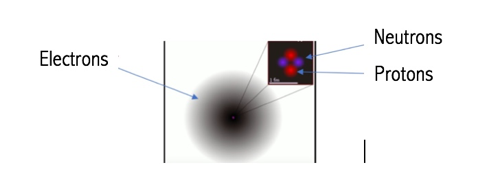
In an atom, we never know the exact position of electrons. Instead, we describe a region of probability indicating where an electron is most likely to be found. For this reason, Figure 1 is not an accurate representation of an atom.
In Figure 2, the darker area within the blurred region indicates where the probability of finding electrons is higher. This fuzzy region surrounding the nucleus is known as an orbital.
We can identify the second image as a helium atom because it has two protons—its atomic number is 2. The atomic number is what distinguishes one element from another in the universe.
In stable atoms, the number of protons is typically balanced by neutrons, which help stabilize the nucleus. In helium, the two positively charged protons would naturally repel each other, but neutrons act as a stabilizing force, helping to hold the nucleus together.
Subatomic particles are not best understood as solid bits of matter, but rather as concentrated bundles of energy. These energy bundles form the fundamental building blocks of the physical world.
This raises deeper questions: if everything is energy, what is energy made of? And what do we really mean by “high” or “low” vibration in practical terms?
The electromagnetic force plays a fundamental role in the universe. It is responsible for holding electrons around the nucleus, as the positively charged nucleus attracts negatively charged electrons. This interaction between positive and negative charges underlies electromagnetic force, which is present everywhere and in everything. What we often describe in health contexts as “energy” or “vibration” can be understood more precisely as the quality and organization of this electromagnetic energy within the body.
The Sound of Atoms
Scientists have demonstrated that sound waves can interact with a single atom, causing it to emit sound in return—even at a scale where such waves can scarcely exist. The atom absorbs energy from these subatomic vibrations and responds by generating phonons, which are extremely small units of sound. Although these sound waves are far too faint for the human ear to detect, researchers have successfully amplified them to make the sound audible.
Quantum Field Theories
Physicists today rely on a framework known as quantum field theory (QFT), first proposed in the late 1920s and refined over many decades. While powerful, QFT can feel unintuitive at first.
To build some intuition, consider electrons. Throughout the entire universe exists something called the electron field. An individual electron is not the field itself; instead, it is a small, localized excitation—or vibration—of that field. In fact, every electron we observe is simply a similar vibration of this one underlying field.
This idea extends to all particles. There are fields for photons, quarks, gluons, muons—indeed, for every known particle. What we perceive as a particle is just a localized ripple in its corresponding field. Even the Higgs boson fits this picture. The Higgs field interacts with other particles and gives them mass, yet the field itself is difficult to observe directly. Instead, scientists inject energy into it during high-energy collisions, causing it to vibrate. Detecting the Higgs boson is therefore equivalent to observing these vibrations of the Higgs field.
This perspective radically changes how we think about the subatomic world. Space is not empty; it is filled everywhere with multiple overlapping fields, much like a single location can simultaneously contain sound, color, and scent. Particles are simply the observable manifestations of these fields in motion.
This framework also reshapes our understanding of particle interactions. For example, when two electrons scatter off each other, a simplified classical picture suggests that one emits a photon, recoils, and the photon is then absorbed by the other electron, causing it to recoil as well. This is often compared to two people in boats: if one throws an object to the other, both boats move in response—the thrower from the act of throwing, and the catcher from receiving it.
The Abstract Idea
The quantum realm reshapes our understanding of existence, revealing a reality far different from what we ordinarily perceive. Remarkably, it forms the very foundation of everything that exists. If all of physics is grounded in quantum principles, then those principles ultimately define reality itself. Yet, what they reveal is how much remains unknown. There exists a vast range of phenomena that seem to lie beyond the limits of human intellect—something greater than what we can fully grasp. At this boundary, only mysticism and philosophy begin to approach these mysteries, offering ways to sense and contemplate what science has not yet fully explained.
.


Comments